PLANET OF LANA II
CHILDREN OF THE LEAF
Introduction
My aim in working on this project was to create interesting, otherworldly environments that encourage the player to explore, maintains smooth movement, and highlights the story through the environment.
Specification
-
Worked on both Level Design & Level Art
-
Created multiple biomes, working from pen and paper sketches to first art pass
-
Team of around 25 people
-
Created using Unity
THE STORY

Synopsis
When out exploring with her niece, a Dijinghala ship drops a gas-leaking crystal, poisoning Anua. To save her niece’s life, Lana and Mui venture out to find the ingredients for her medicine, taking them on an adventure all over Novo. While exploring new areas of the world, Lana meets new people, learns about the history of her home planet, and sees how the different factions deal with the new technology introduced in the first game.
My responsibilities
I worked both on Level design and Level art.
-
sketched out worldmaps of new biomes
-
blocked out in engine using probuilder
-
itterated and playtested puzzles
-
added a first art pass
-
added colliders and grabbable edges
-
added different cameras & set them up
-
worked with level streaming
BUILDING NOVO

A big part of my role at Wishfully was putting together a world map of new biomes based on the script, concept art, and designed puzzles.
Working with the script, I would write down story beats and sentences describing the environment, or ideas I felt could be conveyed to the player through environmental storytelling.
Seeing key scenes in the concept art gave me a great deal of inspiration for the look and feel of the space, imagining what might happen before and after each scene.
When adding puzzles, it was a fun challenge to make each area feel like a logical space, placing them in a specific order to match the intensity and beats of the story.
DEMOA PROCESS
Starting with pen & paper
Key concept art by Jimmy Chan


After reading through the script and while looking at the key concept art I always start out sketching the new area with pen and paper. Here is a first draft of the water biome, Demoa. I always try out different solutions and draw multiple versions before settling on what to base my blockout on.
This was the first area I got the opportunity to design from start. I compiled my sketches into a more detailed drawing and presented my ideas and diagrams to the directors and game designers. With the feedback from the meeting and from my lead, I had the green light to start blocking out in the engine.
Demoa in three stages
%20map_edited.jpg)
Early world map & diagram
Puzzle blockout
Alpha art pass
The top stage is a compiled sketch I created marking out the different beats happening throughout the level, accompanied by a rough diagram showing where the player feels safe or unsafe in the environment. The second stage is a very rough blockout of some of the different puzzles I based on sketches by the game design team. From there I space them out, playtest and iterate, and then translate the shapes with assets into a believable environment.
The third stage includes an art pass on the overall level, I worked alot with rock-formations and foliage, both in the underwater scenes and the small island inbetween.
The overall shape and story beats in Demoa remain from the original world map. The idea was to go from light and colorful, with smaller rooms to deeper ocean and darker colors with more open water as danger increases.
Blockout - First art pass - Final
Cutscene by Mattias Skärhed-Ohlsette
From this quote in the script I started to develop the sub-spotting scene. The video shows the same sequence in three different stages of development.
First is a blockout created with probuilder meshes where I am trying out the flowyness of the movement. The second is with a first art pass, I've iterated on the path, added cameras, changed out the blocks for rocks and added some vegetation. The final version is captured from the finished game with sound, more effects and a refined camera track.
"At the edge of one of the islands, LANA and MUI observe a DIJINGALA GUARD while hiding in tall grass. [...] He’s sitting in a SUBMARINE floating just off the beach. [...] It disappears down the ocean below.
LANA and MUI follow. They catch up to THE SUBMARINE as it stops by a rock formation by the reef. From a distance they observe it extracting a GRATTO CRYSTAL using a giant magnet attached to the bottom. The submarine continues deeper down the ocean. If LANA and MUI attempt to follow, their oxygen runs out."
PUZZLING WITH GAME DESIGNERS


As mentioned, I worked closely with the game designers at Wishfully. I received sketches from the lead game designer ranging from early concepts to fully drawn plans for finished puzzles. My main tasks were to incorporate them into the environment, playtest them, and iterate on the movement and flow.
Although this did vary from puzzle to puzzle, sometimes I felt inspired to come up with my own ideas and changes, i'd test them, and pitch them back to the designers. Other times, we would have dedicated meetings or simply exchange ideas through Slack messages to discuss ongoing work and possible improvements.
Working closely with Dan Faxe and Christian Enfors taught me a great deal about both game and puzzle design, and I am very grateful that they included me in their process.
Elevator puzzle
Puzzle sketch by Dan Faxe


This area takes place entirely underwater. The player controls a sub-bot and can lift and drop weights to change the position of an elevator.
In the first version, the challenge was to time entering the elevator and dropping a weight to make it descend. When we tested this version in blockout, I realized that once the player got into the elevator, they could simply push it down with the sub-bot and reach the exit, bypassing the intended challenge.
With this in mind, I tested a new version. The player weighs down the elevator, enters the elevator room, and removes a large weight from inside it. The elevator then rises, clearing the path forward.
The problem with this solution was that it required too many back-and-forth trips with the sub-bot, and moving a large weight out of the elevator felt clunky.
The game designers continued to iterate on the puzzle, and the solution that made it into the final game is much cleaner. The player removes the large weight from the top of the elevator and replaces it with a smaller one, opening the path forward. This requires fewer trips, avoids the clunky task of moving a large weight out of the elevator itself, and still allows the player to feel clever by reusing a smaller weight from an earlier, accessible room.
STORYTELLING IN WEMARI
Sketches and inspiration
Key concept art by Jimmy Chan


When I started to sketch the layout for Wemari, I already had a few scenes I knew we wanted to use: a big fallen tree as a bridge, the painting of the sacred deer, a reveal of the Wemari people, and the key concept art of Lana meeting the deer for the first time.
Using these scenes as a starting point and weaving in puzzles from the game design team, it started to come together.
I was very inspired by the large Blekinge oaks from where I grew up, the wilderness of the forest in the childrens book Ronia the robber's daughter as well as redwood forests. I watched and took screenshots of slow-TV videos of people hiking in the national parks to study the scale and try to replicate the height differences in the forest.
Introducing the Wemari people
In the first area of Wemari, we were very careful not to include anything man-made until a powerful reveal.
The only man-made element before the introduction is a wall painting of the sacred deer that Lana is looking for, showing her that she is on the right track.
For the reveal, I wanted to show that these people are powerful and against the robots. Inspierd by the quote from the script I thought about what would happen to the robots after they were trapped or defeted in battle. Using them as a scare tactic for new ones to come and showing of their power by displaying them on stakes.
I also wanted to convey the feeling of entering a new territory, creating a split between what has been and what is to come.
Having Lana jump into the water and sneak in from an underground tunnel shows that it’s not easy to get into their territory, and gives a break in the way of movement going from running to swiming.
GAMEPLAY
Ten minutes of gameplay
In this video, you can see a snippet of gameplay from Planet of Lana 2. Here, Lana and Mui are breaking into a city through underground tunnels.
I thought I’d take you with me and give you a quick rundown of working on these three areas: the wasteland, sewers, and rooftops.
WASTELAND
Hostile environment
Concept art by Johannes Winkler Gurstafsson
"They finally reach the city walls. They stand several hundred meters tall, but luckily are still under construction. LANA and MUI use a hole in an incomplete part of the wall to sneak through."
This environment is a big shift from what we expect Novo to look like. As the sun rises the cool blues of the night turn into grays and browns, with trash and metal scraps everywhere. The air feels heavy and foggy, and the water feels contaminated.
Working on this area, my focus was to convey the chaos from these concept art sketches, with unstable ground and tight crawlspaces leading out into huge vistas of trash mounds. Half exposed, half hidden, but always uncertain.


SEWERS
Creating fun with creatures
The Inkfish is one of the creatures you can control through Mui. This tiny little fish fits perfectly into tight spaces. It can create ink clouds to help lana stealth past underwater cameras, leap over the surface, and move very fast, even around sharp corners.
This area is designed to showcase all of these abilities and let the player have some fun with them. The basis of this puzzle was created by the game design team, but while blocking out I iterated on the path, added more pipe areas and we made changes in the order of obstacles.
ROOFTOPS
Hardcore! Parkoure!

When I started working on this area, I had this concept art in mind: Lana is looking out over the inside of the wall, across a lush city filled with high-rises.
Because the last fish puzzle is quite long and takes place in a tight, dark area, I wanted to give the player a chance to run around and jump through this new, brighter environment.

Realizing it would be quite a journey going from the sewers to a view like that, I wanted the player to really feel the change in altitude.
I was inspired by parkour videos showing people running across rooftops, taking giant leaps between buildings, and climbing scaffolding, highlighting alternative ways to move through the space.
ISSUES & SOLUTIONS
Making an underwater level great
When I got the task to start working on Demoa, I started by doing some research. I had heard that having swiming and waterbased levels a lot of the times can lead to trouble. After watching some youtube-essays and reading up on the topic I could see that I had quite a challenge ahead of me.
Having an underwater level in a game can really be a big hit or miss. It can work as a great change-up in traversal and gives the opportunity for new, fun mechanics.
If not done carefully, it can instead be incredibly frustrating for the player, limiting their range of movement and giving them a timed challenge between every air point.
Our bubbly solution
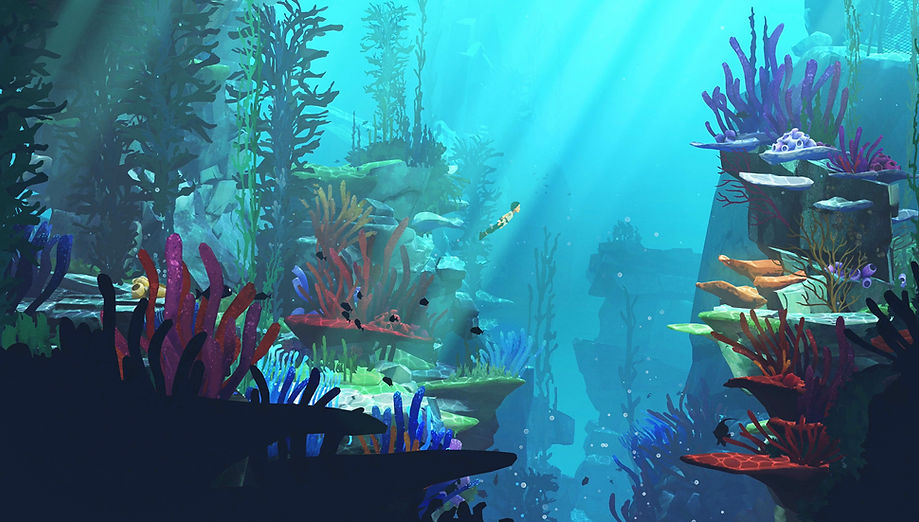
When we first started working on Demoa, we only had the surface and air pockets under cliffs as air points. With the addition of the bubble coral, it opened up new possibilities. We could expand areas that were first thought to be caves into larger bodies of open water, while still giving Lana the ability to swim along the ocean floor, seeing the beautiful underwater world of coral and cliffs.
Another challenge was to make the player bring Mui along for the ride. Mui is afraid of water and has to be carried by Lana in a special lily pad flower. Another way to bring Mui along was through electric jellyfish, which the player has to release from the bottom without getting burned. These creatures did not only help with traversal; they also created opportunities for fun puzzle ideas.
CLOSING THOUGHTS
Having my internship and then working at Wishfully was a blast through and through. I absolutely fell in love with the story of Lana and Mui, and it has been so cool to see players from all over enjoying the game we created.
One of the differences I noticed going from my Level design education at The Game Assembly into working at Wishfully is the approach to the "10 second rule". It is basically that something has to happen every 10 seconds or the player will lose interest. Often when talking to my lead about areas I've blocked out, the feedback would be something along the lines of, "it's great but make the running stretches longer, and when you think they are too long, add even more".
At first I thought this was wild, but sometimes the player just needs some downtime. If you don’t provide it in-game, they will find it elsewhere. The 10 second rule I had gotten so used to at TGA, a school with main focus on the AAA genre, had turned into a "30 second rule".
I ended up working with my own combo,
a soft 10 and big 30. A soft 10 change could be something as simple as a shift in the background or an angle change of the ground. A big 30 would be more in the likes of swinging across something with a rope or diving into the water.
I think this approach works really well for this type of game. The painterly environments, the beautiful music and challenging puzzles really shine.
I am very happy with my time working on Planet of Lana II. It was super interesting and challenging to learn more about level art, platformer level design, and puzzle creation. A huge thank you to my lead, Rickard Schiller Harvey, and the game design team, Dan Faxe and Christian Enfors.
Thank you to the directors Adam Stjärnljus and Klas Eriksson for inviting me to be a part of this incredible team and for all the appreciation and feedback you have given me.
Do check out the incredible 3D and concept artists: Jimmy Chan, Anna Löfberg, Mathilde Béguinot, Vargdis Åslund, and Johannes Winkler Gustafsson.
And a special shoutout to the best quiz team, Quizfully, Tove Laursen, David Hamark & Anna Löfberg for making my year in Gothenburg such a lovely memory to look back on!


Project showcase


